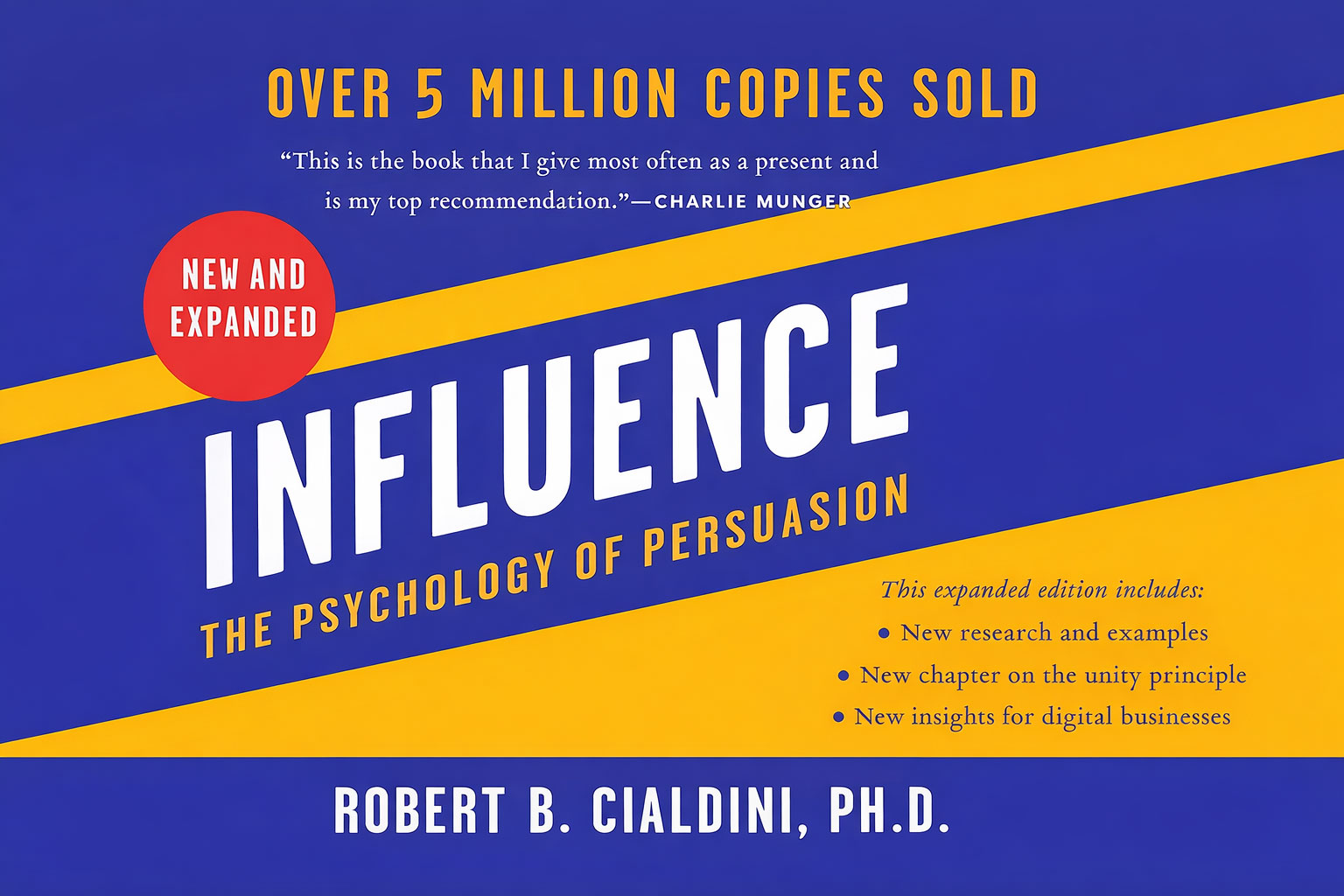
Influence: The Psychology of Persuasion – Robert Cialdini – 6 psychological principles that make you easily persuaded


Introduction: Why Influence Is Considered the Most Important Book on Persuasion in the World
In the fields of marketing, psychology, and the art of persuasion, few books have achieved the lasting impact and global influence of Influence: The Psychology of Persuasion by Robert B. Cialdini.
First published in 1984, the book quickly became a classic—taught in top business schools and regarded as the “bible” for marketers, sales professionals, negotiators, managers, behavioral experts, and anyone interested in how humans make decisions.
What makes Influence truly exceptional?
It’s not just theory
Cialdini spent three years going undercover inside sales organizations, charities, fundraising groups, telemarketing teams, and more—observing how people are actually persuaded. It is one of the few books that combines behavioral psychology research with real-world fieldwork.
The six principles remain accurate after 40 years
Even in the era of social media, advertising overload, and e-commerce, Cialdini’s principles still operate—arguably more powerfully than ever.
Universally applicable
Influence can be applied across:
- Marketing & sales
- Negotiation
- Leadership
- Communication
- Behavioral psychology
- Branding
- UX and customer experience design
→ It is a framework for understanding and shaping human behavior.
Detailed Summary – The 6 Immutable Principles of Persuasion by Robert Cialdini
The entire book revolves around six psychological “weapons” that determine why people say “yes.” These are not tricks—they are biological and social mechanisms hardwired into the human brain.
Let’s break down each principle.
Reciprocity
(When someone gives you something, you feel compelled to give something back.)
This is a foundational rule of human society. People dislike feeling indebted, so they tend to reciprocate—even when the initial gift is small.
Real examples:
- Restaurants offering mints → customers tip more.
- Free trials → dramatically increase purchase rates.
- Free ebooks, checklists → readers become more open to the next offer.
Why it’s powerful:
Reciprocity was a survival rule in ancient human societies—cooperation increased the chance of survival.
Marketing applications:
- Free offers: ebooks, trials, resources
- Freemium → upsell
- Personalized gifts → higher conversion
Commitment & Consistency
(Once we say “A,” we want to act in ways that stay consistent with that initial choice.)
People strongly dislike internal contradiction.
Famous tactic:
Foot-in-the-door technique
Step 1: Small request → Step 2: Larger request → Higher chance of agreement.
Examples:
- Subscribing to an email list → more likely to buy later
- Allowing notifications → more interactions
- Answering a small survey → more likely to accept a consultation
In everyday life:
- Someone who signs up for the gym is more likely to attend
- Publicly declaring goals increases completion rates
Social Proof
(When uncertain, people look to others to decide what to do.)
If many people choose something, we assume it must be good.
Examples:
- 5-star reviews boost conversions
- “1,200 people have already registered” builds trust
- Viral videos attract more views simply because they’re viral
Online environment:
- Testimonials are one of the strongest persuasion tools
- Social metrics shape brand credibility
Liking
(We say YES more easily to people we like.)
Cialdini highlights three sources of liking:
✔ Similarity
We trust people who resemble us.
✔ Genuine compliments
A sincere compliment changes emotional states.
✔ Familiarity
Repeated exposure builds affinity.
Applications in business:
- Personal branding
- Storytelling to build connection
- Friendly, relatable interface design
- Brand ambassadors
Authority
(People tend to obey experts or those with recognized credibility.)
Even signals of authority can influence choices:
- Degrees
- Uniforms
- Titles
- Brand reputation
- Data demonstrating expertise
Examples:
- “Doctor recommended” increases sales
- Cited research increases credibility
- Subject-matter influencers outperform generic KOLs
Scarcity
(People value things more when they are rare.)
This principle drives FOMO.
Examples:
- “Only 3 items left”
- “Register within 24 hours to receive bonuses”
- Limited edition products
Why it works:
Humans are more afraid of losing opportunities than eager to gain them (Loss Aversion).
You may also like
>>> Top 9 Best Business Books That Will Change Your Life—and Your Career—Forever
Why Influence Remains Valuable Today
The principles are instinctive, not trendy hacks
They originate from prehistoric survival mechanisms and therefore transcend time.
Cialdini uses real experiments and field observations
Not theoretical speculation—his insights came from:
- Car dealerships
- Fundraising teams
- Direct sales
- Telemarketing
- PR specialists
- Retail shops
Perfectly applicable in the digital age
The principles are even stronger today due to:
- Social media
- Personalization technology
- Big data
- Digital marketing
- E-commerce
They form the backbone of UX, CRO, content marketing, and modern sales funnels.
Applications of Influence in Marketing & Business
Content Marketing
- Social proof → testimonials, case studies
- Authority → expert quotes
- Reciprocity → free ebooks, checklists
E-commerce
- Scarcity → countdown timers
- Social proof → 5-star reviews
- Liking → founder’s personal branding
Sales
- Small commitments → demos, free trials
- Authority → expert positioning
- Reciprocity → free consultations
Leadership
- Liking → relationship building
- Authority → competence + credibility
- Commitment → team agreements
Negotiation
- Reciprocity → strategic concessions
- Social proof → “Most companies choose this option”
- Consistency → reminding counterparts of their stated goals
Strengths of the Book
- Easy to read – simple stories, no heavy jargon
- Highly practical – applicable immediately
- Scientifically grounded – based on research
- Suitable for multiple professions – marketers, salespeople, leaders, HR, founders, teachers, etc.
Limitations (Good to Know Before Reading)
- Some examples are dated (1980s–1990s), though the principles remain accurate
- Overuse may lead to manipulation instead of ethical persuasion
- Some readers may prefer the updated edition Influence: New & Expanded
Who Should Read This Book?
- Marketers who want higher conversions
- Salespeople seeking better persuasion
- Leaders wanting stronger influence
- Behavioral researchers & psychologists
- Online business owners
- Anyone wanting to understand why they make certain decisions
Key Quotes (Paraphrased)
– “People use psychological shortcuts to make decisions. Whoever controls the shortcuts controls the choices.”
– “We underestimate the power of social proof and overestimate our independence.”
– “To change behavior, start by changing commitment—even a small one.”
Conclusion: What Does Influence Mean for the 21st-Century Reader?
Influence is not just a book about persuasion.
It is a map of the human mind:
- Why we trust certain people
- Why we buy things we don’t need
- Why crowds influence us so strongly
- Why we say “yes” without realizing it
In the age of social media, big data, and AI, these principles haven’t faded—they’ve become more sophisticated.
Reading Influence helps you:
- Persuade ethically
- Protect yourself from manipulation
- Understand human motivations
- Develop leadership, communication, and business skills
If you work in marketing or business, Influence is a book you should read at least once in your life.