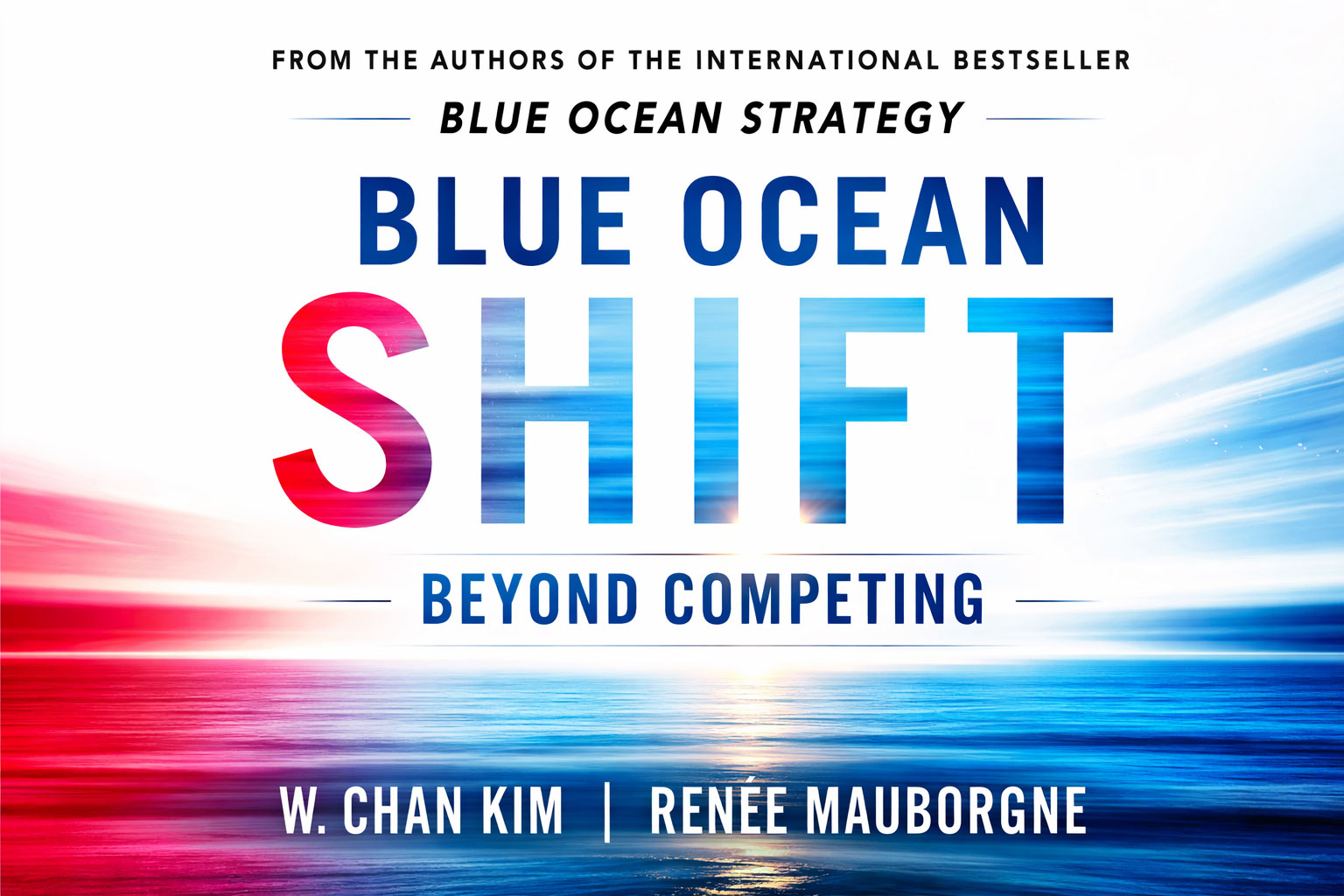
Blue Ocean Shift is a highly influential strategy book, regarded as one of the works that reshaped the way people think about business. The book not only presents the theory behind blue ocean strategy but also offers practical, actionable steps for real-world application. The authors guide readers on how to build the confidence to take action by breaking down processes, enabling direct exploration, and applying structured methodologies—ultimately helping organizations create new markets and achieve sustainable, profitable growth.

Introduction to W. Chan Kim and Renée Mauborgne
W. Chan Kim (born 1951) is a Korean strategy scholar and one of the most influential thinkers in modern business. He is a Professor of Strategy and Management at INSEAD and Co-Director of the INSEAD Blue Ocean Strategy Institute in Fontainebleau, France. In 2009, he received the Nobels Colloquia Prize for Leadership in Business and Economic Thinking for his outstanding contributions to global business strategy.
Renée Mauborgne (born 1963) is a renowned business strategy expert and the co-author of the seminal book Blue Ocean Strategy. Together with W. Chan Kim, she introduced the concept of the “blue ocean,” helping companies break free from fierce competition and create uncontested market space.
Introduction to Blue Ocean Shift
Blue Ocean Shift is the follow-up to the groundbreaking Blue Ocean Strategy. The book not only explains the difference between “red oceans” and “blue oceans” but also provides step-by-step guidance for organizations—including corporations, startups, nonprofits, and government agencies—to create new markets and achieve sustainable growth.
Key Ideas and Core Frameworks in Blue Ocean Shift
- Shifting from Competition to Market Creation
Instead of battling in saturated, competitive markets (the red ocean), the authors encourage businesses to create “blue oceans”—entirely new market spaces with strong growth potential.
The core of this approach is value innovation: delivering superior value to customers while optimizing operational costs. - The Five-Step Process of a Blue Ocean Shift
Unlike many strategy books that remain theoretical, Blue Ocean Shift presents a practical five-step process for organizations to execute the transition:
- Analyzing the market landscape
- Identifying opportunities
- Developing ideas
- Selecting the optimal strategy
- Implementing in practice
The book also emphasizes that people—mindset, culture, and innovation spirit—are the decisive factors in successful transformation.
- Practical Strategic Tools
Some of the most notable frameworks from Blue Ocean Strategy and Blue Ocean Shift include:
- Six Paths Framework – exploring new directions to expand the market
- Four Actions Framework – eliminate, reduce, raise, and create
- Strategy Canvas – a strategic map to identify competitive positions and new value opportunities
- Real-World Case Studies
The authors present a wide range of cases—from B2C and B2B companies to nonprofit organizations—demonstrating how various entities successfully applied blue ocean strategies.
They also introduce the concept of non-disruptive creation: generating new solutions without destroying existing models, which reduces risk and increases applicability. - Value and Low Cost
- Chan Kim’s Blue Ocean Strategy introduces the concept of creating a value breakthrough for both customers and businesses, thereby opening up uncontested market spaces—known as “blue oceans.” In this framework, value is considered a fundamental element, emphasizing that companies must actively innovate their value propositions to adapt to market shifts and evolving customer needs.
Value innovation does not mean simply expanding product offerings or upgrading technology. Instead, it is about shifting toward a blue ocean strategy—simultaneously increasing value while reducing competition to achieve superior performance.
Moreover, value innovation breaks away from the traditional trade-off between value and cost. Companies that pursue a blue ocean strategy must learn how to differentiate while also lowering costs. This book provides a fresh mindset on how businesses can create new value. At the same time, the authors outline a clear roadmap that helps companies build competitive advantage and sustain their position in the market.
Who Should Read Blue Ocean Shift?
This book is ideal for:
- Executives, managers, and startup founders seeking new markets or business model innovation
- Companies struggling in intense competition and looking for sustainable growth
- Social organizations, nonprofits, or government agencies aiming to restructure or create new value for the community
It is especially useful for those who want to reposition a brand, innovate products or services, or explore unmet customer needs.
Strengths and Limitations of Blue Ocean Shift
Strengths
- Highly practical with clear, actionable processes
- Visual strategic tools that support clearer thinking
- Rich examples applicable across industries and contexts
- Strong emphasis on people and culture—an often-overlooked factor in other strategy models
Limitations
- Not all industries can easily find “blue oceans”
- Niche or highly specialized fields may face limited applicability
- Transformation requires significant mindset and cultural shifts—challenging for rigid or conservative organizations
Conclusion and Reading Recommendations
Blue Ocean Shift is an action-oriented strategy book for anyone seeking to break out of saturated competition and pursue sustainable growth. As you read, it is helpful to analyze your own industry, apply tools like the Strategy Canvas, and actively discuss ideas with your team to build internal alignment.
Top 9 Business Books That Will Change Your Life—and Your Career—Forever